
From memes to workplace chats, NSFW has become a common term online. NSFW stands for “Not Safe For Work,” a warning used to indicate content that may be inappropriate or explicit for professional or public settings, like gaytt. NSFW meaning reflects caution, context awareness, and online etiquette — from adult content and graphic images to strong language or sensitive topics.
Today, the term is also widely associated with creative tools such as an nsfw art generator, which produces adult-themed visuals meant for private viewing and responsible use.
People often use the term in everyday life, for example:
- “Don’t open that 67 link here—it’s NSFW.”
- “This one shot is hilarious, but definitely NSFW.”
In this article, we’ll explain what NSFW means, explore its origin, show how it’s used in different contexts, and share examples that highlight its growing importance in digital culture.
What Does “NSFW” Mean?
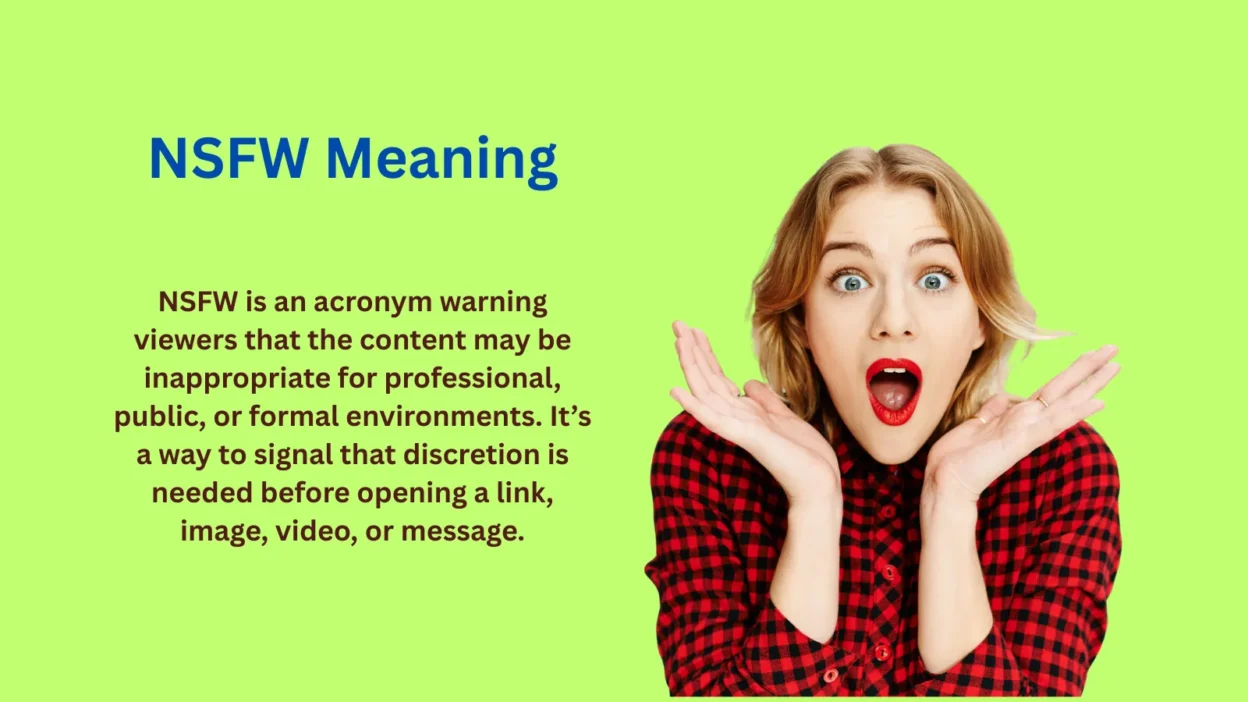
NSFW is an acronym warning viewers that the content may be inappropriate for professional, public, or formal environments. It’s a way to signal that discretion is needed before opening a link, image, video, or message.
Example Sentences:
- “He tagged the article NSFW, so I waited until I got home to read it.”
- “NSFW content should always be shared with caution.”
Key Points to Remember:
- NSFW = Not Safe For Work — content not suitable for work or public view.
- It promotes awareness, respect, and discretion in online interactions.
- NSFW shows up in memes, videos, and forums. It often uses slang terms like DL.
- It’s a global digital etiquette term, signaling potential adult or explicit material.
Background & History
The term NSFW emerged in the early 2000s with internet forums, email chains, and early social media platforms. It became a necessary warning as adult or graphic content started circulating online more freely.
- Early Internet: NSFW was primarily used in workplace emails and bulletin boards to prevent accidental exposure.
- Social Media Era: With Reddit, Twitter, and Tumblr, NSFW became a standard tag for content filters and community guidelines.
- Modern Usage: Today, NSFW isn’t limited to adult content—it can refer to violence, gore, or controversial humor.
Usage in Various Contexts
NSFW isn’t restricted to one type of content—it’s widely used across texting, social media, and professional settings.
In Texting:
- “Just sent you a link, NSFW 👀.”
- “NSFW alert! Don’t check this at work.”
On Social Media:
- Users tag posts as #NSFW to warn followers.
- Example: “New comic uploaded! #NSFW #MatureContent.”
In Gaming:
- Some gaming communities label mods, fan art, or chat channels as NSFW.
- Example: “This character skin mod is NSFW.”
Professional Contexts:
- NSFW is also used internally to flag sensitive documents or emails.
- Example: “The attached report contains NSFW images—review with discretion.”
Common Misconceptions & Clarifications
- “NSFW only means adult content.”
Not exactly. It can include graphic violence, strong language, or controversial material. - “NSFW is inappropriate for all environments.”
It depends on context. At home or on private devices, NSFW content may be perfectly fine. - “Using NSFW is offensive.”
No. It’s a cautionary label, not a judgment.
Example Dialogue:
- Alex: “Why is this NSFW tag everywhere?”
- Jamie: “It’s just a heads-up—you don’t want to get caught opening it at work!”
Similar Terms & Alternatives
Here are a few related expressions often used instead of or alongside NSFW:
| Term | Meaning | Use Example |
|---|---|---|
| SFW | Safe For Work | “This meme is SFW, share freely at work.” |
| NSFL | Not Safe For Life | “Graphic content ahead—NSFL warning.” |
| Mature Content | Age-restricted material | “This game has Mature Content.” |
| Explicit | Contains strong language or sexual content | “Explicit lyrics, listen with caution.” |
Each term clarifies the nature of content, but NSFW specifically signals content unsuitable for professional or public settings.
How to Respond to This Term
When someone labels something NSFW, your response depends on tone and setting.
Casual:
- “Got it! I’ll wait until I’m home.”
- “NSFW vibes—love the heads-up!”
Funny:
- “NSFW? Challenge accepted!”
- “Oops, I opened it at work…send help!”
Professional:
- “Noted, I’ll review privately.”
- “Thanks for the NSFW warning—viewing responsibly.”
Privacy-conscious:
- “Appreciate the caution!”
The key is acknowledging the warning and respecting boundaries.
Regional or Cultural Differences
NSFW is widely recognized online, but usage can vary:
- US & UK: Common in workplace and internet forums.
- Japan: Used for adult media, gaming, and anime fan communities.
- Pakistan & India: Increasingly used in social media for memes and content warnings.
- Europe: Often combined with SFW content filters on forums and sites.
Across regions, NSFW consistently signals discretion and awareness.
Comparison with Similar Terms
| Expression | Focus | Difference from NSFW |
|---|---|---|
| Explicit | Language or sexual content | NSFW is broader and includes professional context |
| NSFL | Extreme content | NSFW is less severe, suitable for work warning |
| Mature | Age-appropriate | NSFW warns about context, not just age |
NSFW blends etiquette, caution, and content awareness, while other terms may focus on content type or severity.
Usage in Online Communities & Dating Apps
Reddit, TikTok, Discord:
- NSFW tags are standard for filtering or moderating content.
- Example hashtags: #NSFW #Mature #AdultOnly
Dating Apps:
- Users may mention NSFW in bios to indicate preferences or humor.
- Example: “Flirty humor, memes, NSFW chats welcome 😉.”
Gaming:
- NSFW content appears in fan art, mods, or in-game chat channels — often marked to prevent unwanted exposure.
Hidden or Offensive Meanings
NSFW generally has no offensive meaning.
However, sarcasm or exaggeration can imply poor taste: “This meme is NSFW…what were they thinking?”
Tone and emojis usually clarify intent.
Suitability for Professional Communication
NSFW is acceptable when used for warnings, content moderation, or internal discussions.
In formal business settings, it’s better to use professional alternatives like:
- “Contains sensitive material”
- “Restricted content for workplace viewing”
Example:
- Instead of “NSFW report attached,” say “Attached file contains sensitive material—please review privately.”
FAQs
- What does NSFW stand for?
NSFW stands for “Not Safe For Work.” - Is NSFW slang or formal?
Informal but widely recognized online and in workplaces. - Why is NSFW used?
To warn viewers about inappropriate content for public or professional environments. - Can NSFW content be safe at home?
Yes, NSFW only indicates unsuitability for work or public settings. - Is NSFW always adult content?
No. It can include graphic images, language, or controversial material. - Can I say NSFW in emails?
In casual or creative teams, yes. In formal contexts, use “sensitive content” or “restricted content.”
Conclusion
NSFW meaning goes beyond a simple label—it’s about awareness, caution, and digital etiquette. From workplace emails to social media posts, NSFW helps people navigate content safely and responsibly. Whether you’re browsing memes, chatting online, or moderating content, remembering NSFW ensures discretion and respect for others’ boundaries.
Next time you see NSFW, know it’s not just a warning—it’s a culture of mindful content sharing.