
Critical thinking is one of the most valuable skills you can develop, whether you are a student, professional, or lifelong learner. It helps you analyze information, make better decisions, solve problems efficiently, and think creatively. But like any skill, critical thinking grows stronger with practice. That’s where critical thinking exercises come in—they are simple yet powerful ways to train your brain to question assumptions, evaluate evidence, and reason logically.
In this article, we’ve gathered a variety of critical thinking activities, from fun brain teasers and logic puzzles to practical problem-solving exercises for everyday life and the workplace. By incorporating these exercises into your daily routine, you can sharpen your mind, enhance your reasoning skills, and become more confident in making decisions. Let’s explore how to practice and master critical thinking step by step.
What is Critical Thinking?
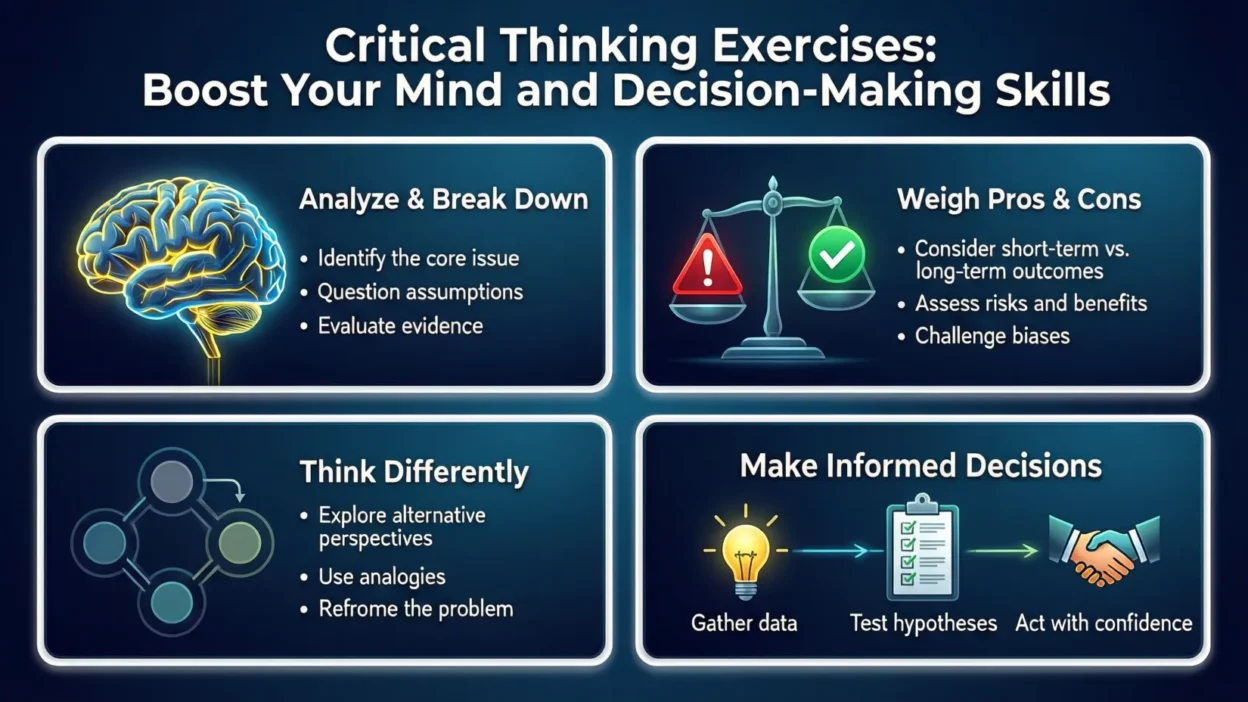
Critical thinking is the ability to analyze information, evaluate evidence, and make reasoned decisions. It is not just about knowing facts but understanding how to use them effectively. Developing this skill allows you to solve problems logically, avoid biases, and think clearly in every situation.
Key Components of Critical Thinking:
- Analysis: Breaking down complex information into smaller parts to understand it better.
- Evaluation: Assessing ideas, arguments, and evidence for accuracy and relevance.
- Reasoning: Drawing logical conclusions based on evidence and facts.
- Problem-Solving: Finding practical solutions to challenges using careful thought.
Why It Matters:
- Helps students excel in academics by improving comprehension and reasoning.
- Supports adults in making informed decisions in daily life.
- Enhances workplace skills like leadership, teamwork, and strategic thinking.
By practicing critical thinking exercises, you strengthen these components and train your mind to think more clearly and effectively.
Why Practice Critical Thinking Exercises?
Practicing critical thinking exercises is more than just a mental workout—it shapes how you analyze, decide, and solve problems in every part of life. These exercises train your brain to be sharp, logical, and open-minded.
Benefits of Critical Thinking Exercises:
- Improves Cognitive Skills: Strengthens memory, focus, and logical reasoning.
- Enhances Decision-Making: Helps you evaluate options and choose the best solutions.
- Boosts Creativity: Encourages thinking outside the box and finding innovative solutions.
- Increases Confidence: Builds trust in your judgment and problem-solving abilities.
- Reduces Bias: Teaches you to recognize assumptions and avoid faulty reasoning.
- Supports Academic Success: Students can analyze texts, solve problems, and excel in tests.
- Strengthens Professional Skills: Improves leadership, teamwork, and strategic thinking.
- Encourages Lifelong Learning: Makes learning new concepts easier and more effective.
By consistently practicing critical thinking activities, you train your mind to react thoughtfully rather than impulsively, making every decision smarter and more informed.
Critical Thinking Exercises for Students
Students can develop critical thinking skills through fun and engaging activities that sharpen their reasoning, problem-solving, and analytical abilities. These exercises not only improve academics but also prepare them for real-life challenges.
Effective Exercises for Students:
- Brainstorming Sessions: Encourage students to list all possible solutions to a problem before evaluating them.
- Mind Mapping: Create visual diagrams to connect ideas and organize information logically.
- Scenario Analysis: Present real-life situations and ask students to propose solutions.
- Debates: Practice defending different viewpoints to understand multiple perspectives.
- Questioning Assumptions: Ask “Why?” and “What if?” questions to challenge ideas.
- Case Studies: Analyze short stories or articles and identify the main problem and solutions.
- Logic Puzzles: Solve riddles or pattern-based puzzles to strengthen reasoning.
- Role-Playing Exercises: Simulate situations to make decisions and solve conflicts.
- Reflection Journals: Write daily reflections on decisions and thought processes.
- Peer Review Activities: Evaluate classmates’ work critically and constructively.
By including these critical thinking exercises, students can strengthen their ability to analyze, reason, and solve problems effectively, creating a strong foundation for lifelong learning.
Critical Thinking Exercises for Adults
Adults can benefit from critical thinking exercises in daily life, work, and personal growth. These activities help make better decisions, solve problems efficiently, and enhance creativity.
Practical Exercises for Adults:
- Daily Reflection: Take 10 minutes each day to reflect on decisions you made and analyze the outcomes.
- Evaluate News & Information: Critically assess news articles, social media posts, or reports for accuracy and bias.
- Thought Experiments: Imagine different scenarios and think through possible consequences of your actions.
- Question Assumptions: Challenge your beliefs by asking “Why do I think this?” or “What evidence supports this?”
- Pros-and-Cons Analysis: Make lists to weigh options before making decisions.
- Problem-Solving Challenges: Identify a minor problem at work or home and brainstorm multiple solutions.
- Learn Something New: Take a course or hobby and analyze patterns, strategies, or results.
- Mind Mapping: Organize ideas visually to clarify complex decisions.
- Discuss & Debate: Share opinions with friends or colleagues and consider alternative perspectives.
- Journaling: Write down thoughts, analyze situations, and track personal progress in reasoning skills.
By regularly practicing these exercises, adults can strengthen logical reasoning, creativity, and decision-making skills, improving both personal and professional life.
Brain Teasers to Improve Critical Thinking
Brain teasers are a fun and effective way to challenge your mind, boost logic, and improve problem-solving skills. They encourage creative thinking while strengthening analytical abilities.
Effective Brain Teasers:
- Riddles: Solve tricky questions that require careful reasoning.
- Example: “I speak without a mouth and hear without ears. What am I?”
- Answer: An echo
- Pattern Recognition: Identify sequences in numbers, letters, or shapes.
- Example: What comes next? 2, 4, 8, 16, …
- Answer: 32
- Word Puzzles: Unscramble letters or find hidden words to stimulate analytical thinking.
- Lateral Thinking Challenges: Think “outside the box” to solve unconventional problems.
- Logic Puzzles: Solve problems by eliminating impossible options.
- Example: Three friends A, B, C have different pets. Use clues to find which pet belongs to whom.
- Math-Based Puzzles: Apply numbers and reasoning to find solutions.
- Observation Exercises: Spot differences between two similar images or find hidden objects.
- Sequence Puzzles: Arrange events or steps in the correct logical order.
- Memory Games: Remember and recall patterns, numbers, or objects to enhance focus.
- Spot the Error Challenges: Find mistakes in sentences, images, or calculations.
Regularly solving brain teasers trains your brain to think critically, analyze information, and spot patterns, making everyday problem-solving easier and more effective.
Logic Puzzles for Analytical Skills
Logic puzzles are a fantastic way to develop reasoning, focus, and analytical thinking. They require you to examine facts carefully, make connections, and solve problems step by step.
Effective Logic Puzzles:
- Sudoku: Fill a 9×9 grid so that each row, column, and 3×3 box contains all numbers from 1 to 9.
- Boosts pattern recognition and problem-solving.
- Grid Puzzles: Use clues to determine relationships between different items.
- Example: Who lives in which house, or who owns which pet?
- Sequence Challenges: Identify the next item in a logical series of numbers, shapes, or letters.
- Deductive Reasoning Puzzles: Solve problems by ruling out impossible scenarios.
- “If-Then” Scenarios: Analyze conditional statements to find conclusions.
- Matching Exercises: Pair clues with correct answers to enhance attention to detail.
- Critical Observation Puzzles: Spot inconsistencies or anomalies in information.
- Logic Mazes: Find the correct path using rules and constraints.
- Number Riddles: Solve puzzles requiring arithmetic reasoning.
- Problem-Solving Games: Play board or card games that require strategic thinking.
By practicing logic puzzles regularly, you train your brain to think critically, analyze situations, and approach problems methodically, skills that are valuable in both studies and real-life decision-making.
Decision-Making Exercises
Decision-making exercises help you analyze options, weigh consequences, and make better choices in daily life, academics, and the workplace. These activities train your brain to be deliberate, logical, and confident.
Effective Decision-Making Exercises:
- Pros-and-Cons Lists: Write down advantages and disadvantages before making any decision.
- Scenario Analysis: Imagine different outcomes for a decision and evaluate which is best.
- Role-Playing Exercises: Act out situations to practice making choices in real-life scenarios.
- Prioritization Challenges: Decide which tasks or problems to tackle first and why.
- “What If” Questions: Consider alternative paths and possible consequences of decisions.
- Case Studies: Analyze real or hypothetical problems and propose solutions.
- Group Decision Exercises: Work with others to make collective decisions and discuss reasoning.
- Time-Bound Decisions: Make choices within a limited time to simulate pressure situations.
- Reflection Journals: Record past decisions, analyze the process, and learn from mistakes.
- Ethical Dilemmas: Practice evaluating choices that involve moral or ethical considerations.
Regularly practicing these exercises improves your critical thinking, judgment, and problem-solving skills, making you more confident in handling both simple and complex decisions.
Creative Thinking Activities
Creative thinking exercises encourage you to think outside the box, generate innovative ideas, and approach problems differently. Combining creativity with critical thinking strengthens overall problem-solving skills.
Effective Creative Thinking Exercises:
- Lateral Thinking Puzzles: Solve problems using unconventional approaches.
- Example: “A man walks into a bar, asks for water, and the bartender points a gun at him. Why?”
- Story-Building Exercises: Create a story from random words or images to develop imagination.
- Idea Generation Games: Brainstorm multiple uses for common objects (e.g., a paperclip).
- Mind Mapping: Connect different ideas visually to explore new perspectives.
- “What Could Go Wrong?” Analysis: Imagine potential obstacles in a plan and think of solutions.
- Reversing Assumptions: Challenge norms by asking “What if we did the opposite?”
- Creative Problem-Solving Challenges: Solve real-world problems with innovative approaches.
- Combination Exercises: Merge unrelated concepts to create new ideas.
- Improv Scenarios: Practice quick thinking and adaptability in spontaneous situations.
- Art-Based Activities: Draw, sketch, or design to explore visual problem-solving and creativity.
By practicing these exercises, you strengthen your ability to approach problems from multiple angles, combining logic and imagination to make smarter decisions in life, work, and learning.
Interactive Critical Thinking Games
Interactive games make critical thinking practice fun, engaging, and social. They challenge your reasoning, decision-making, and problem-solving skills in real time.
Best Interactive Critical Thinking Games:
- 20 Questions: Guess an object, person, or place by asking yes/no questions.
- Escape Room Challenges: Solve a series of puzzles to “escape” a scenario, improving logic and teamwork.
- Chess or Strategy Board Games: Plan moves ahead, anticipate opponents’ actions, and think strategically.
- Trivia Games: Test knowledge and reasoning under time pressure.
- Mystery Solving Games: Analyze clues to solve a crime or scenario.
- Debate Games: Take turns defending opposing viewpoints to enhance reasoning and communication.
- Online Brain Training Apps: Use digital games designed to improve memory, logic, and problem-solving.
- Collaborative Puzzles: Work in teams to solve complex riddles or logic problems.
- Role-Playing Simulations: Act out real-life challenges and make decisions as a character.
- Observation and Spot-the-Difference Games: Train attention to detail and analytical skills.
By regularly engaging in these interactive games, you can sharpen your mind, enhance problem-solving skills, and learn to think quickly and logically, all while having fun.
Problem-Solving Scenarios
Problem-solving scenarios help you apply critical thinking to real-life situations, improving decision-making, reasoning, and practical skills. These exercises teach you to analyze information, identify solutions, and evaluate outcomes.
Effective Problem-Solving Exercises:
- Real-Life Situations: Analyze a common issue (e.g., managing time or finances) and propose multiple solutions.
- Step-by-Step Challenges: Break complex problems into smaller steps to solve systematically.
- Spot the Assumptions: Identify hidden assumptions in a scenario before choosing a solution.
- Cause-and-Effect Exercises: Examine problems and determine their root causes and consequences.
- Decision Trees: Map out possible outcomes to choose the best course of action.
- Conflict Resolution Scenarios: Solve interpersonal or team conflicts logically and fairly.
- Workplace Case Studies: Analyze business problems and suggest effective strategies.
- “What Would You Do?” Exercises: Practice ethical or challenging decision-making situations.
- Simulated Projects: Plan and execute small projects, solving problems that arise along the way.
- Reflective Analysis: After solving a problem, review your approach and identify improvements.
By practicing these problem-solving scenarios, you strengthen your ability to think critically under pressure, make informed decisions, and tackle challenges efficiently in both personal and professional life.
Critical Thinking for Workplaces
Critical thinking is a key skill in professional environments. It helps improve decision-making, teamwork, and problem-solving, making employees and leaders more effective.
Workplace Critical Thinking Exercises:
- Case Study Analysis: Review a real or hypothetical business scenario and propose solutions.
- SWOT Analysis Exercises: Analyze strengths, weaknesses, opportunities, and threats for a project or strategy.
- Group Brainstorming Sessions: Collaboratively generate ideas and evaluate them critically.
- Role-Playing Simulations: Practice handling difficult conversations, negotiations, or customer interactions.
- Problem-Solving Workshops: Break teams into groups to solve work-related challenges.
- Pros-and-Cons Decision Exercises: Weigh options for important business decisions before taking action.
- Risk Assessment Challenges: Evaluate potential risks in projects and propose mitigation strategies.
- Critical Review of Reports: Analyze reports or proposals for errors, assumptions, and biases.
- Strategic Planning Activities: Develop plans considering multiple factors and outcomes.
- Debrief Sessions: Reflect on past projects and decisions to learn lessons for future improvements.
Practicing these exercises regularly helps professionals think clearly, act decisively, and approach challenges strategically, boosting overall workplace efficiency and productivity.
Daily Habits to Strengthen Critical Thinking
Incorporating simple daily habits can gradually improve your critical thinking, making decision-making and problem-solving easier in everyday life.
Daily Critical Thinking Habits:
- Journaling Thoughts: Reflect on daily decisions, challenges, and lessons learned.
- Ask “Why” and “What If”: Challenge assumptions and explore alternatives in everyday situations.
- Read Critically: Analyze articles, books, or news for accuracy, bias, and reasoning.
- Mindful Observation: Pay attention to details in your surroundings and consider multiple interpretations.
- Solve Small Puzzles: Dedicate a few minutes to brain teasers, Sudoku, or logic games.
- Question Opinions: Before agreeing, consider evidence and reasoning behind statements.
- Practice Decision-Making: Make intentional choices and reflect on outcomes.
- Learn Something New: Pick up a new skill, hobby, or topic and analyze it critically.
- Discuss Ideas: Share and debate thoughts with friends or colleagues to gain perspective.
- Reflect on Mistakes: Review errors and think critically about what went wrong and why.
By making these habits a regular part of your life, you can continuously sharpen your mind, enhance reasoning skills, and become a more confident decision-maker.
Common Mistakes in Critical Thinking
Even with practice, it’s easy to fall into habits that weaken critical thinking. Being aware of these mistakes helps you think more clearly and make better decisions.
Common Critical Thinking Mistakes:
- Jumping to Conclusions: Making decisions without sufficient evidence.
- Confirmation Bias: Only seeking information that supports your existing beliefs.
- Overgeneralization: Drawing broad conclusions from limited examples.
- Ignoring Context: Failing to consider the bigger picture or background information.
- Emotional Reasoning: Letting feelings override logic and facts.
- Assuming Causation: Believing one event caused another without proof.
- Lack of Reflection: Failing to review past decisions and learn from mistakes.
- Poor Questioning: Asking vague or leading questions that don’t explore the issue.
- Relying on Authority: Accepting information as true just because an expert said so.
- Overcomplicating Simple Problems: Adding unnecessary steps instead of finding straightforward solutions.
Tip: Practicing critical thinking exercises regularly helps you recognize and avoid these mistakes, leading to more accurate, logical, and effective decision-making.